Ten essential albums that define my musical taste
I could not be so pompous as to refer to the following ten albums as “the best.” Music is inherently subjective, and I am one human out of seven-plus billion currently living on this wretched orb. My opinions on the subject are no more or less valuable than those of anyone else. These are simply the albums that have resonated the most with me out of any that I have listened to so far. Now that this disclaimer has exonerated me from having to interrogate my cultural biases (most of these albums were made primarily by white North American men), I can begin! In chronological order:
In a Silent Way (1969) by Miles Davis

There isn’t much I can add to the discourse about Miles Davis, as he’s arguably the most famous and widely discussed jazz guy of all time. But the man was a genius. In a Silent Way, largely ignored by audiences at the time but critically regarded as one of his greatest works, is a testament to that. The interplay between Davis’ trumpet, Joe Zawinul’s organ, and John McLaughlin’s electric guitar is intoxicating. Jazz gets a reputation for being self-indulgent and repetitive – and this album certainly fits that description, consisting of a mere two songs stretched out over nearly 40 minutes – but that’s a selling feature to me. The format of the genre allows me to zone out, as I get to experience masters of their craft noodling away on their instruments for extended periods of time, uninterrupted by human speech. This makes it the perfect album for both work and relaxing around the house. And to think that Davis recorded In a Silent Way and Bitches Brew in the same year!
Remain in Light (1980) by Talking Heads
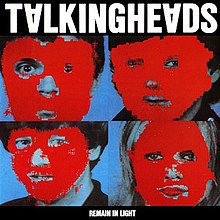
For my money, this album’s first three songs – “Born Under Punches (The Heat Goes On),” “Crosseyed and Painless,” and “The Great Curve” – are as strong as any three-song run on any other album. The back half of Remain in Light flags a bit, but it doesn’t even matter. Sure, I could say stuff like, “the band pulled influences from funk, jazz, punk, and Afrobeat, creating syncopations that sound busy but never overwhelming,” but the reality is – those three songs I just mentioned? Good as hell!
Laughing Stock (1991) by Talk Talk
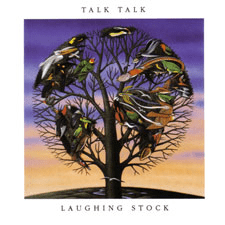
Considering that the band’s previous album, Spirit of Eden, was released to commercial indifference and a mixed critical response, it boggles the mind to consider what Polydor was thinking when they signed the band ahead of the release of Laughing Stock. After all, EMI loathed Spirit of Eden so much that they sued the band over the label’s assertion that they’d deliberately made an album that wasn’t “commercially satisfactorily.” Lead singer Mark Hollis’ open contempt for record label feedback only intensified with Laughing Stock. Hollis’ frequent arguments with studio personnel led him to grow disillusioned with the music industry and retire from it altogether, living out the rest of his life in relative obscurity.
The album is slow and meditative for most of its runtime, which makes the occasional abrasive freak-outs (particularly the one halfway through the nine-minute centrepiece “After the Flood”) even more invigorating. But mainstream audiences don’t want “contemplative,” they want “catchy.” There’s nothing wrong with that, of course, but it can have the effect of discouraging the creation of truly interesting work. Laughing Stock stands as an excellent display of commitment to artistry in the face of financial pressure. Talk Talk entered the scene in the early 1980s as one of many semi-interchangeable synth pop acts, drawing comparisons to fellow British new wavers Duran Duran. They left as an improvised experimental jazz duo. The former iteration was far more profitable; the latter was more authentic.
Kid A (2000) by Radiohead
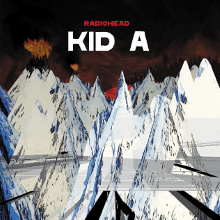
This is unabashedly a nostalgia pick. Radiohead was one of the first bands I got into in high school, at the recommendation of my best friend. Right from the opening few bars of “Everything in Its Right Place,” I could tell I was listening to something special. The ominous beeps and boops of glitchy synthesizers played in minor keys, overlaid with Thom Yorke’s anguished falsetto and cryptic lyrics, were just plain neat to an anxious teenager who didn’t feel like they belonged anywhere.
Lift Your Skinny Fists Like Antennas to Heaven (2000) by Godspeed You! Black Emperor

I also considered two of their other albums for this slot: F♯ A♯ ∞ (1997) and ’Allelujah! Don’t Bend! Ascend! (2012). Godspeed You! Black Emperor is probably my favourite band. That they released three albums across 15 years that are all in the running for my top 10 is why. Their consistency and longevity are remarkable.
Godspeed weave politics into their nerve-wracking instrumentals in a way that can strike neutral listeners as being crass and self-righteous. To the contrary, there’s no doubt in my mind that it comes from a place of sincere concern for humanity’s perseverance over the death cult of capitalism. In Lifts Your Skinny Fists, the band inserts vocal samples like that of an elderly New Yorker lamenting the decline of Coney Island and a supermarket intercom announcement imploring shoppers to ignore panhandlers, perfectly complementing the atmosphere of dread created by the guitars’ long, haunting drones. The tempo and intensity gradually pick up with time, building to ecstatic crescendo, before falling again – a never-ending cycle of despair and hope.
Yankee Hotel Foxtrot (2001) by Wilco
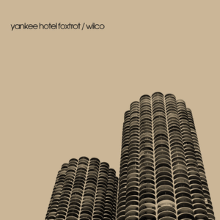
Yankee Hotel Foxtrot is an answer to the age-old question, “Hey, what if somebody made a fairly straightforward folk-rock album but decided to put a bunch of clattering noises and radio static in the background for some reason? Would that be anything?” Wait, no. Reading that back, I think the actual answer to that question is, “Yes, and it sounds like what you’re describing is Yankee Hotel Foxtrot.” I’m sure I could re-word this introduction to be less sloppy, but I’m already this far, so I’ll pass.
Jeff Tweedy’s nearly deadpan vocal delivery can be an acquired taste, but it makes for a perfect contrast to the more sincere lyrics on the album. You can hear him break through his ironic façade when he sings, for instance, “Distance has no way of making love understandable” (“Radio Cure”) or “All my lies are always wishes / I know I would die if I could come back new” (“Ashes of American Flags”). The songs on YHF straddle a difficult balance between sentimental and devil-may-care, and I love that because that’s how I choose to interact with the world! Also, the piano riff immediately following the refrain of “I Am Trying to Break Your Heart” is one of my favourite parts of any song I’ve ever heard. Play that shit at my funeral.
The Disintegration Loops (2002) by William Basinski
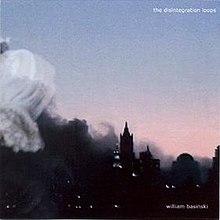
Does listening to the same ten-second ambient tape loop for more than an hour straight sound like your idea of a good time? Does your answer change if I tell you that the loop gradually warps and distorts until the sound is barely recognizable by the end, as the tape disintegrates inside a digital recorder? What do you mean “no”? Where are you going?
The Disintegration Loops are some of the most haunting and beautiful pieces of music ever composed. I find myself returning to them often whenever I feel restless and just need sound to fill my ears. The loops wash over the listener, soothing them while also serving as a reminder of the ephemeral nature of life. Our bodies are decaying as well, performing the same tasks repeatedly every day, until we too – just like the tapes – crumble into dust.
The Magnolia Electric Co. (2003) by Songs: Ohia
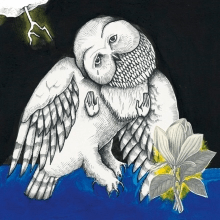
My summary could read simply, “an album so good that I named myself after it,” but I guess I’ll type some other words here. I listened to The Magnolia Electric Co. for the first time in March of 2020, early in the COVID-19 pandemic. The lonesome twang of pedal steel guitars coupled with lyrical meditations on failure, loneliness, and the inevitability of death really struck a chord with me. It was precisely what I needed to hear at the time. “It’s been hard doing anything. Winter stuck around so long. I kept trying anyhow, and I’m still trying now just to keep working,” Jason Molina sings in “Almost Was Good Enough.” The album is full of bleak yet hopeful moments, encouraging perseverance in the face of what seems like insurmountable depression. For as long as my “long, dark blues” persist, so too will my affection for The Magnolia Electric Co.
Reconstruction Site (2003) by The Weakerthans
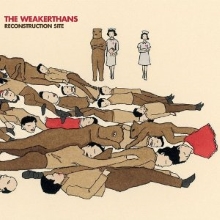
Reconstruction Site was the first CD I ever bought, after seeing The Weakerthans’ performance at the 2005 Winnipeg Folk Festival. I was fascinated by John K. Samson’s lyrics long before I had the critical faculties to understand his use of metaphor and literary references. What first pulled me in was the famous “I hate Winnipeg” refrain in “One Great City!” That immediately registered with nine-year-old me as relatable subject matter for a song. “Hey!” I must’ve thought, “Winnipeg! I know that place! I’m from there!” From then on, I was hooked. The band’s songs are populated with characters that feel fully realized, almost alive, in their loneliness and desire for human connection. I can’t count the number of times I’ve choked up at the final verses of “Plea from a Cat Named Virtute” or “A New Name for Everything.” If I had to pick one of these ten albums as a “desert island disc,” this would be the one.
The Dream Is Over (2016) by PUP

No other band I’ve heard to date so clearly and forcefully articulates the self-loathing that churns constantly through my mind. Above all else, The Dream Is Over is breathtakingly honest. When Stefan Babcock sings about wanting to murder his friends in “If This Tour Doesn’t Kill You, I Will” or about drunk driving down the Don Valley Parkway in “DVP,” it isn’t the scenarios themselves that resonate with me, but rather the desperation and inner turmoil that they reveal about the narrator himself. There’s a certain catharsis in knowing that somebody else is suffering through the same destructive impulses and wallowing in the same self-pity that you are. Being a sad loser never felt so good.
 ruminations of a sad oaf.
One thought on “The Mags 10”